
«Centred» approaches in the education theory and practice: pros and cons
Item ID: 16060
1 Media file
2024/11/01
Citation
eNUPPIR (). «Centred» approaches in the education theory and practice: pros and cons. https://os4.nupp.edu.ua/item/16060
eNUPPIR. "«Centred» approaches in the education theory and practice: pros and cons." Web. . <https://os4.nupp.edu.ua/item/16060>.
eNUPPIR. "«Centred» approaches in the education theory and practice: pros and cons." Accessed . https://os4.nupp.edu.ua/item/16060.
Copied to clipboard
27
Властивості
Тип
Українська
Назва
Англійська
«Centred» approaches in the education theory and practice: pros and cons
Українська
«Центровані» підходи у теорії та практиці освіти: «За» і «Проти»
Автор
Українська
Українська
Опис
Англійська
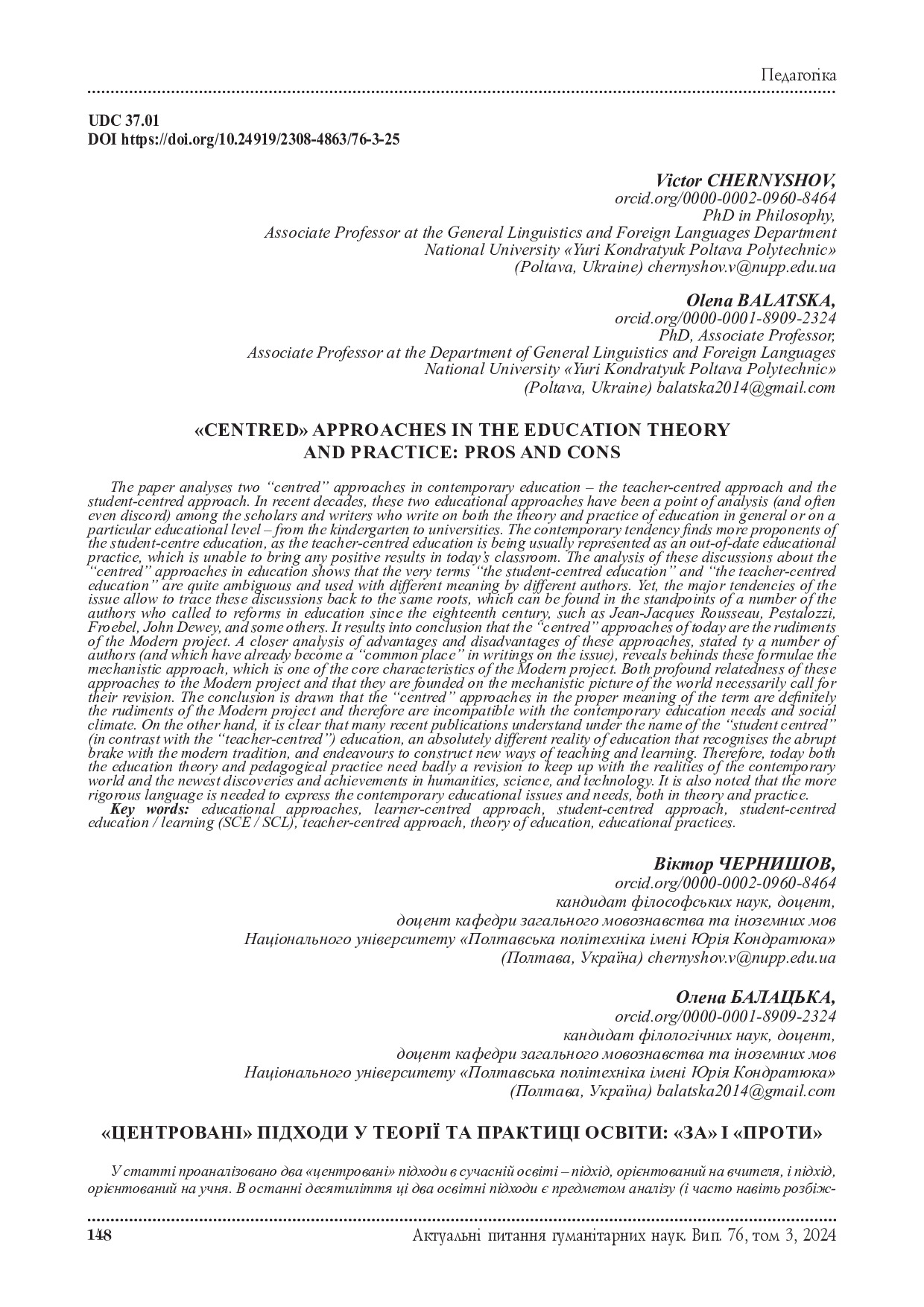
The paper analyses two “centred” approaches in contemporary education – the teacher-centred approach and the student-centred approach. In recent decades, these two educational approaches have been a point of analysis (and often even discord) among the scholars and writers who write on both the theory and practice of education in general or on a particular educational level – from the kindergarten to universities. The contemporary tendency finds more proponents of the student-centre education, as the teacher-centred education is being usually represented as an out-of-date educational practice, which is unable to bring any positive results in today’s classroom. The analysis of these discussions about the “centred” approaches in education shows that the very terms “the student-centred education” and “the teacher-centred education” are quite ambiguous and used with dif ferent meaning by different authors. Yet, the major tendencies of the issue allow to trace these discussions back to the same roots, which can be found in the standpoints of a number of the authors who called to reforms in education since the eighteenth century, such as Jean-Jacques Rousseau, Pestalozzi, Froebel, John Dewey, and some others. It results into conclusion that the “centred” approaches of today are the rudiments of the Modern project.
Українська
У статті проаналізовано два «центровані» підходи в сучасній освіті – підхід, орієнтований на вчителя, і підхід, орієнтований на учня. В останні десятиліття ці два освітні підходи є предметом аналізу (і часто навіть розбіжностей) серед науковців та авторів, які пишуть як про теорію, так і про практику освіти в цілому, так і про окремі освітні рівні – від дитячого садка до університету. Сучасна тенденція полягає у тому, що освіта, орієнтованої на учня знаходить все більше прихильників, тоді як освіта, орієнтована на вчителя, зазвичай представляється як застаріла освітня практика, яка не здатна принести жодних позитивних результатів у сучасному класі. Аналіз цих дискусій про «центровані» підходи в освіті показує, що самі терміни «студентоцентроване навчання» і «вчителецентроване навчання» є досить неоднозначними і використовуються різними авторами у різних значеннях
Мова
Дата випуску
Тематика
Англійська
Англійська
Англійська
Українська
Українська
Українська
Англійська
Англійська
Англійська
Українська
Українська
Українська
Українська
Видавництво
Бібліографічний опис
Українська
Balatska О.L. «Centred» approaches in the education theory and practice: pros and cons / О.L. Balatska, V.V. Chernyshov // Актуальнi питання гуманiтарних наук : міжвуз. зб. наук. пр. молодих вчених Дрогоб. держ. пед. ун-ту ім. Івана Франка. – Дрогобич : Гельветика, 2024. – Вип. 76. Т. 3. – С. 148 – 153 – DOI https://doi.org/10.24919/2308-4863/76-3-25
УДК
37.01
Набори елементів 1
Медіа

Metadata Information
Створено
2024-11-1 14:53
Last Modified
2024-11-1 14:53
Date Issued (DC)
2024
Item ID
#16060
Resource Template
Наукова стаття