Англійська
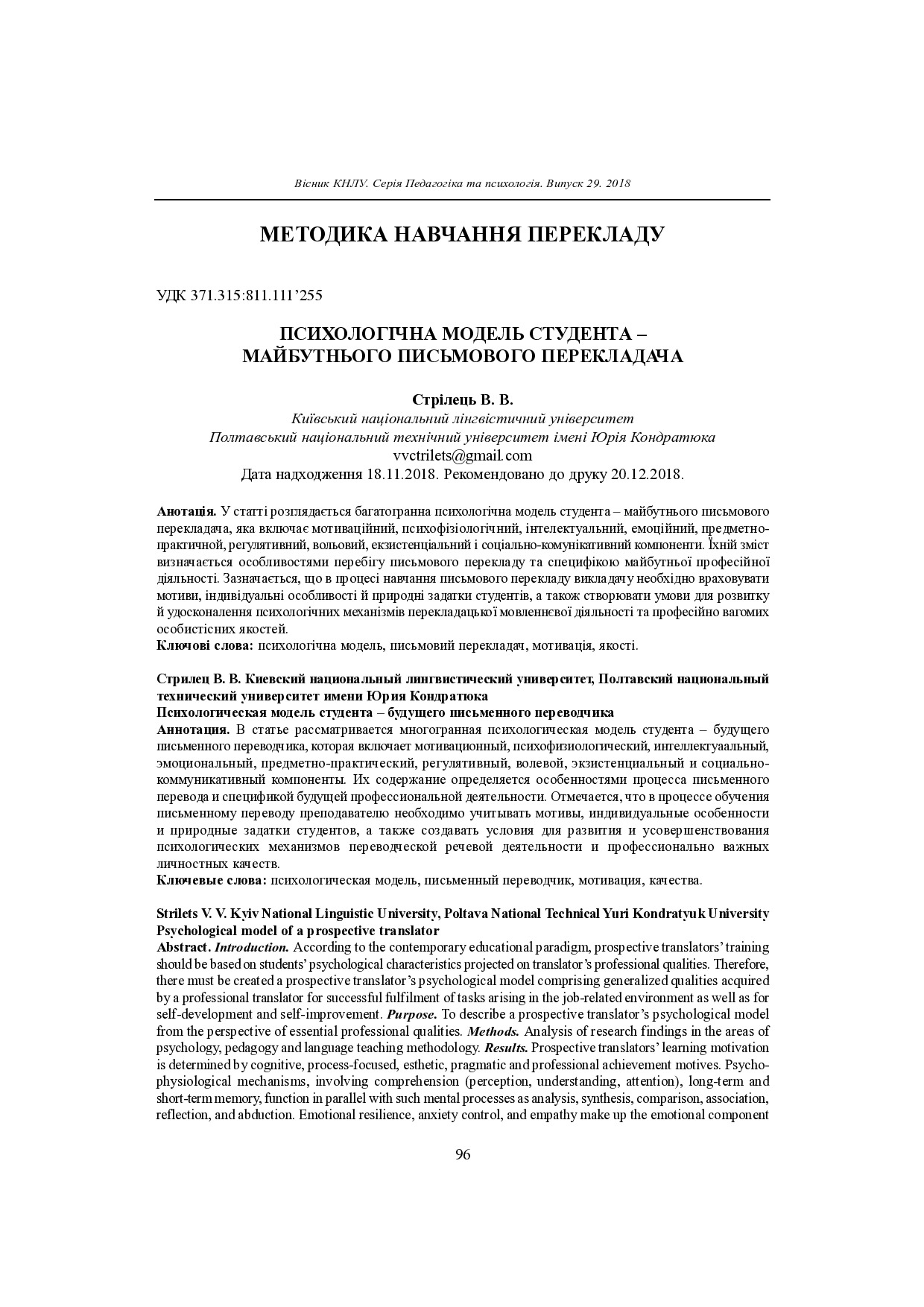
Introduction. According to the contemporary educational paradigm, prospective translators’ training should be based on students’ psychological characteristics projected on translator’s professional qualities. Therefore, there must be created a prospective translator’s psychological model comprising generalized qualities acquired by a professional translator for successful fulfilment of tasks arising in the job-related environment as well as for self-development and self-improvement. Purpose. To describe a prospective translator’s psychological model from the perspective of essential professional qualities. Methods. Analysis of research findings in the areas of psychology, pedagogy and language teaching methodology. Results. Prospective translators’ learning motivation is determined by cognitive, process-focused, esthetic, pragmatic and professional achievement motives. Psycho-physiological mechanisms, involving comprehension (perception, understanding, attention), long-term and short-term memory, function in parallel with such mental processes as analysis, synthesis, comparison, association, reflection, and abduction. Emotional resilience, anxiety control, and empathy make up the emotional component of the model. Its subject-practical constituent implies referring a student to a particular psychological type: cognitive-lingustic / speech-communicative, and introvert / extravert. Regulatory (stress resilience, time management) and conative (determination, persistence, confidence, self-discipline) qualities are important for students’ independent work and life-long learning. Existential component is associated with self-acceptance and personal freedom. Social-communicative constituent comprises team work and managerial skills. Conclusion. A translator trainer should take into account students’ motives, individual qualities and abilities, as well as create favourable conditions for developing and improving psychological mechanisms of translation speech activity and essential professional qualities.
Українська
У статті розглядається багатогранна психологічна модель студента – майбутнього письмового перекладача, яка включає мотиваційний, психофізіологічний, інтелектуальний, емоційний, предметно-практичной, регулятивний, вольовий, екзистенціальний і соціально-комунікативний компоненти. Їх зміст визначається особливостями перебігу процесу письмового перекладу та специфікою майбутньої професійної діяльності. Зазначається, що в процесі навчання письмового перекладу викладачу необхідно враховувати мотиви, індивідуальі особливості й природні задатки студентів, а також створювати умови для розвитку й удосконалення психологічних механізмів перекладацької мовленнєвої діяльності та професійно вагомих особистісних якостей.